
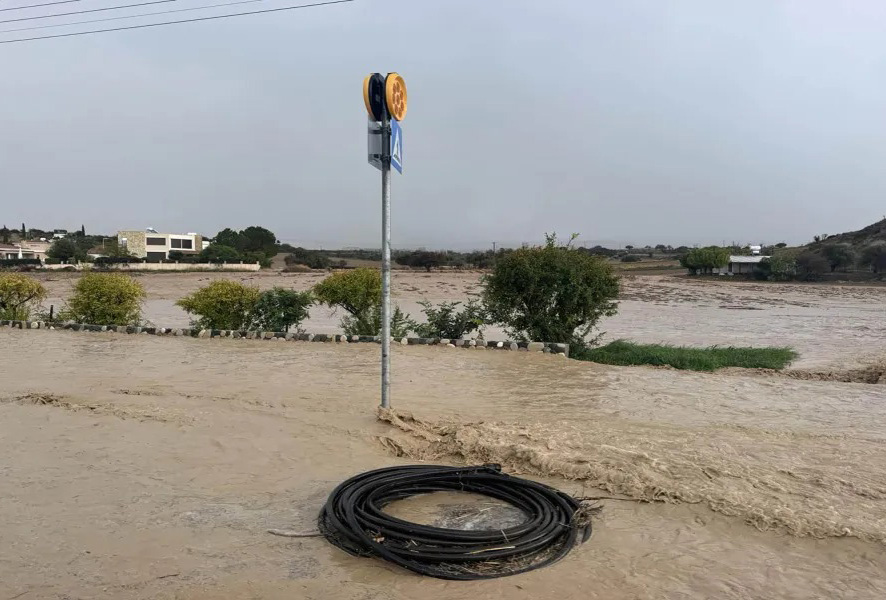
After months of concern over historically low dam levels, this year’s rainfall in Cyprus brought a sense of relief. Reservoirs that only a few months ago stood near critical lows have partially recovered, with water storage levels increasing significantly compared to early 2026.
But rainfall alone does not solve Cyprus’ water crisis.
This year simply reminded us how vulnerable the island remains to climate extremes. Just weeks separated critically low dam reserves from heavy rainfall events that temporarily improved the situation, exactly the kind of instability climate scientists have long warned about.
For Cyprus, water scarcity is no longer a seasonal issue. It is a structural challenge tied to climate change, desertification and the way natural resources are managed.
The island is already recognised as highly vulnerable to desertification under the United Nations Convention to Combat Desertification (UNCCD), while the Mediterranean is considered one of the world’s climate change hotspots. Rising temperatures, declining long-term rainfall trends and growing pressure on water demand continue to strain both ecosystems and communities.
Agriculture lies at the centre of this challenge.
In many parts of Cyprus, agricultural soils contain extremely low levels of organic matter, often below 1 per cent, despite fertile soils generally requiring more than 3 per cent. This significantly limits the soil’s ability to retain moisture, meaning that even when rainfall occurs, much of the water is quickly lost instead of remaining available to crops.
Healthy soil acts as a natural water reservoir. Improving soil organic matter increases water retention, strengthens fertility and improves resilience during dry periods. Without healthier soils, even periods of increased rainfall provide only temporary relief.
This is where circular solutions become increasingly important.
Across Europe, growing attention is being placed on how organic waste streams can become tools for climate resilience. In Cyprus, large quantities of municipal and agricultural prunings, livestock manure and other organic materials are still treated as waste despite their environmental value.
Returning these materials back to the soil through circular management practices can improve moisture retention, reduce dependence on chemical fertilisers and support more sustainable agricultural systems in drought-prone regions.
This approach lies at the heart of NURISH, a Horizon Europe project bringing together 28 partners from 10 countries to strengthen climate resilience and sustainable development in rural and small urban communities through nature-based, technological and circular solutions.
In Cyprus, AKTI Project and Research Centre and the Municipality of Athienou are establishing a Resilience Hub in Athienou focused on the circular management of green waste.
Through a Circular Symbiotic Green Waste Management Scheme, the initiative aims to develop a co-composting system combining agricultural and municipal prunings with livestock manure to produce high-quality, low-cost compost. The model seeks to improve soil health and moisture retention, reduce emissions linked to green waste transport and disposal, lower fertiliser dependence and support a more resilient agricultural sector.
Importantly, the system is designed as a socially fair and economically viable model in which farmers actively participate by contributing organic residues and receiving compost in return. Through soil monitoring, field measurements and local collaboration, the project also aims to develop knowledge and solutions that can later be replicated in other rural regions of Cyprus and Europe.
Because ultimately, the discussion around water scarcity in Cyprus cannot begin and end with whether it rained each year.
Rain may temporarily improve reservoir levels, but resilience is built through healthier soils, smarter resource management and stronger local systems that help communities adapt to a changing climate.
And for Cyprus, adaptation is no longer a future priority. It is already a necessity.